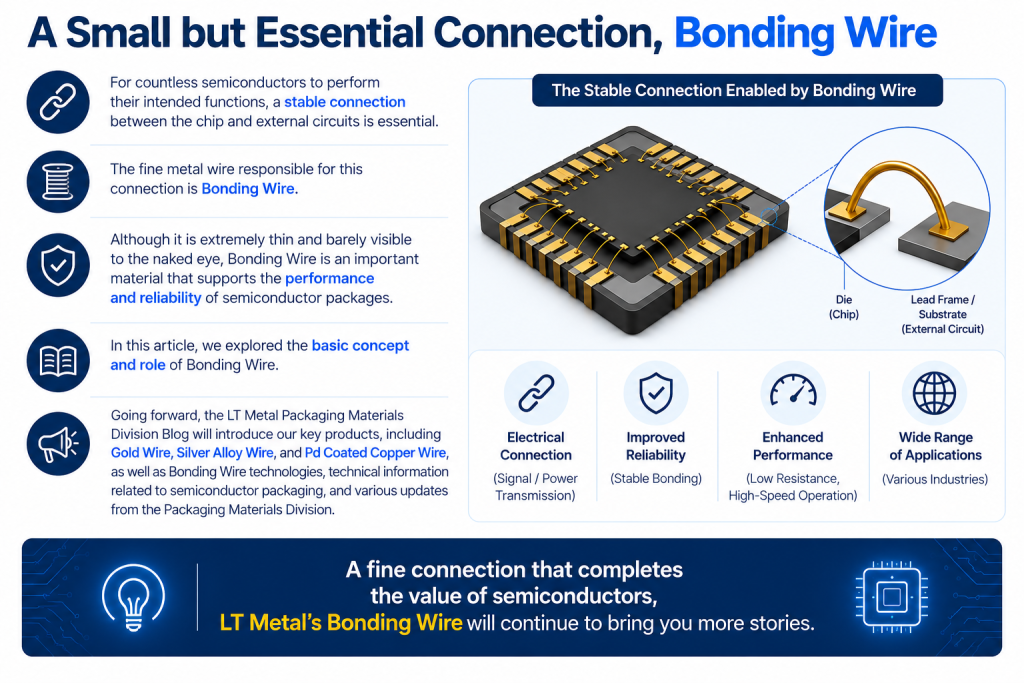

What Is Bonding Wire, a Key Material Connecting Semiconductors?
Key Takeaways
- The role and importance of Bonding Wire, a key packaging material that electrically connects the semiconductor chip (die) to external electrodes
- Material characteristics of major Bonding Wire types, including Gold Wire, Silver Alloy Wire, and Pd Coated Copper Wire
- Key technical factors for reliable semiconductor packaging, including the Wire Bonding process, FAB formation, bonding characteristics, loop formation, and reliability
The First Story from LT Metal’s Packaging Materials Division Introducing Bonding Wire, a fundamental material in semiconductor packaging.
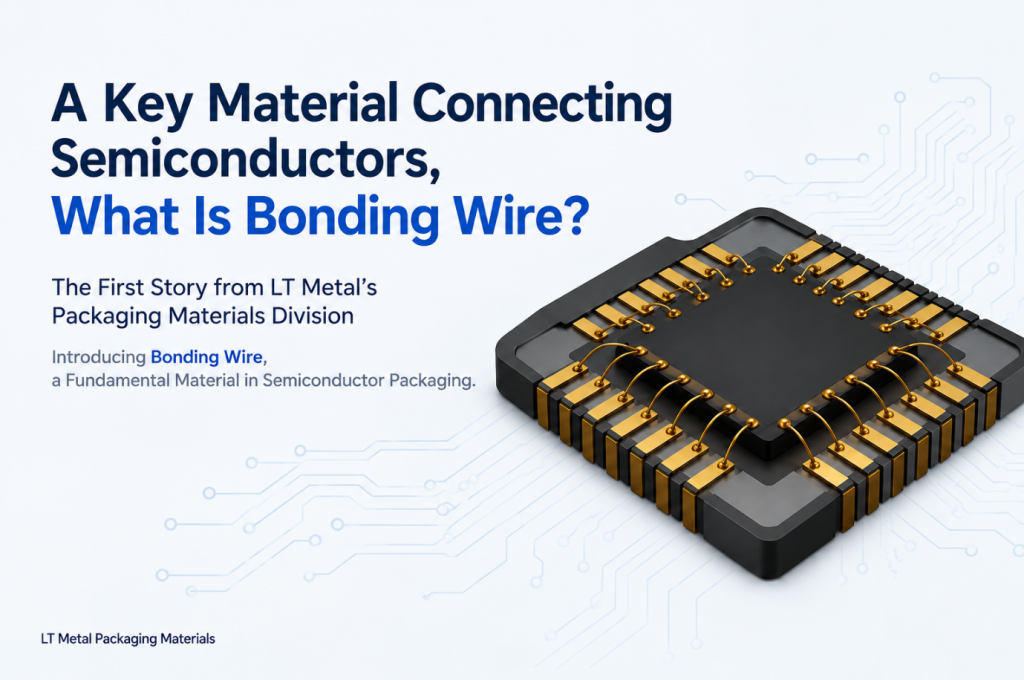
A Fine Metal Wire Connecting the Semiconductor Chip to External Circuits, Bonding Wire
Semiconductors are used in countless electronic devices that we use every day, including smartphones, automobiles, data centers, and home appliances.
For a semiconductor chip to perform its intended function within an electronic device, it must be able to reliably transmit and receive electrical signals between the chip and external circuits.
One of the key materials used to electrically connect the semiconductor chip (die) to the external electrodes of the package is Bonding Wire.
Although Bonding Wire is an extremely fine metal wire that is difficult to distinguish with the naked eye, it is a key packaging material that supports the electrical connectivity and reliability of semiconductor packages.
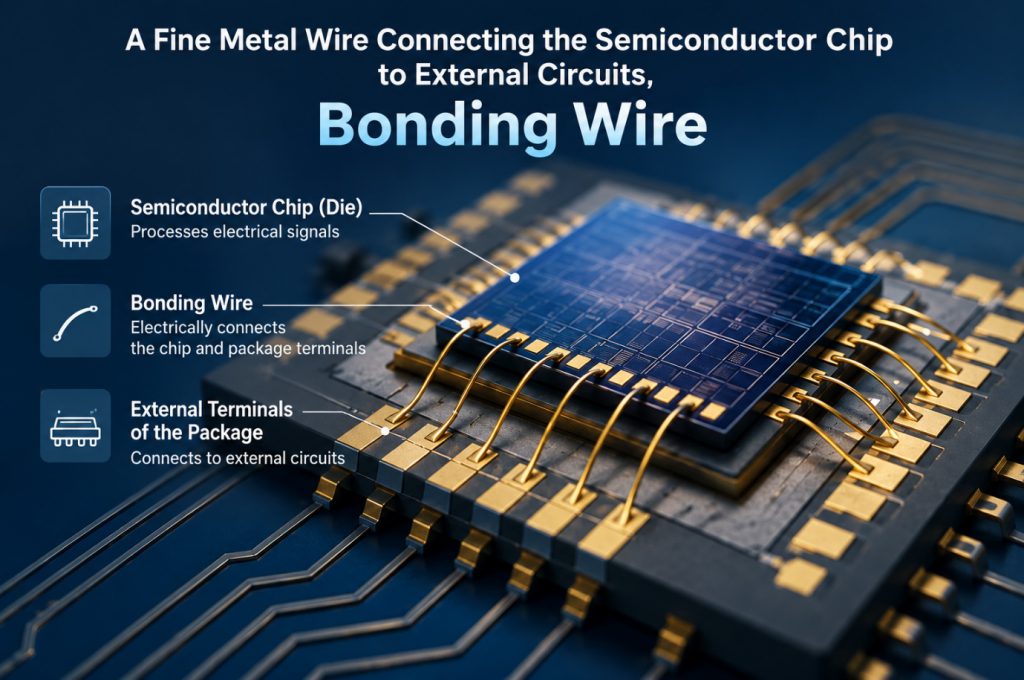
1. What Is Bonding Wire?
Bonding Wire is a fine metal wire that electrically connects the pad of a semiconductor chip to external terminals such as a lead frame or substrate.
A completed semiconductor chip cannot be directly connected to external circuits on its own. Therefore, the packaging process is required to protect the chip while establishing electrical connections to external circuits.
One of the representative technologies used in this process is Wire Bonding.
Simply put, Bonding Wire can be described as “an electrical connection path that links the semiconductor chip to the outside world.”
2. Why Is Such a Thin Wire So Important?
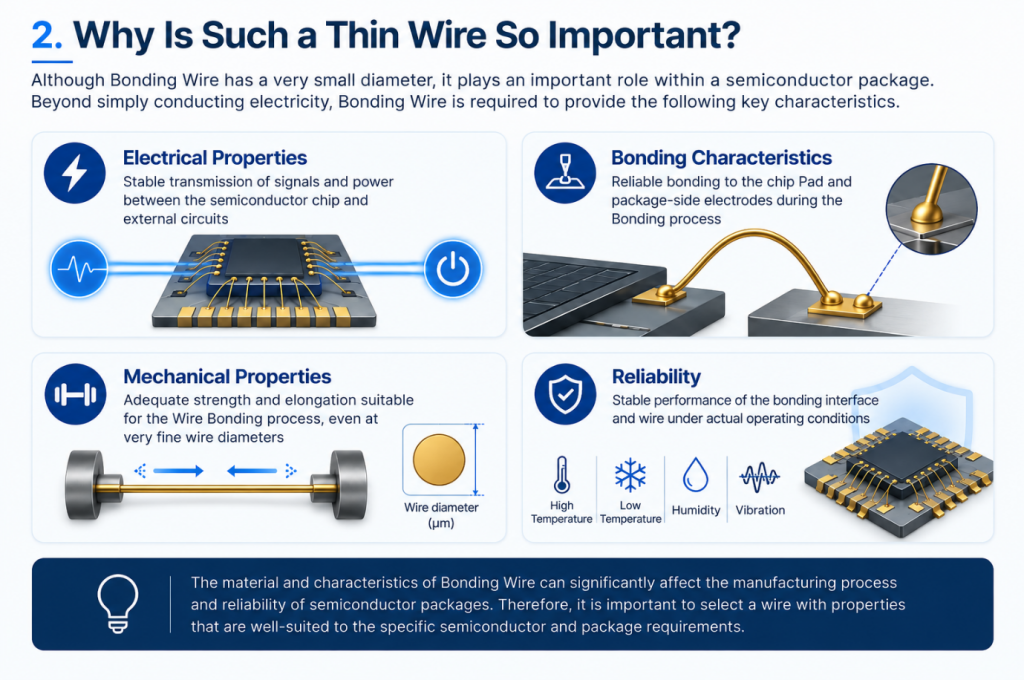
Although Bonding Wire has a very small diameter, it plays an important role within a semiconductor package. Beyond simply conducting electricity, Bonding Wire is required to provide the following key characteristics.
- Electrical Properties : Stable transmission of signals and power between the semiconductor chip and external circuits
- Mechanical Properties : Adequate strength and elongation suitable for the Wire Bonding process, even at very fine wire diameters
- Bonding Characteristics : Reliable bonding to the chip pad and package-side electrodes during the bonding process
- Reliability : Stable performance of the bonding interface and wire under actual operating conditions
3. How Is Bonding Wire Connected?
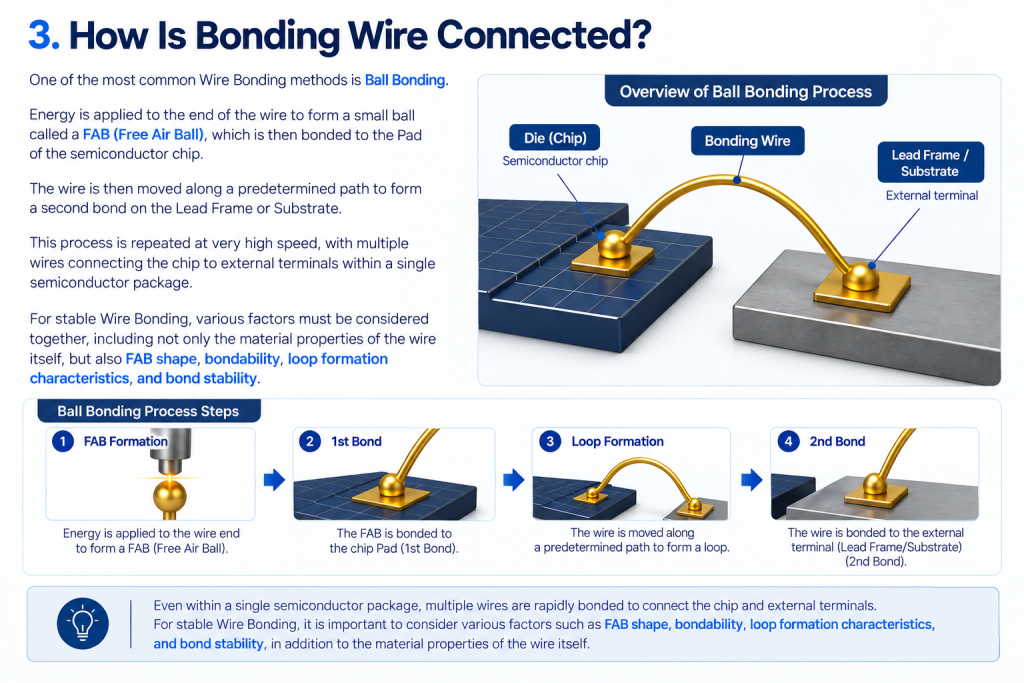
One of the representative Wire Bonding methods is Ball Bonding.
Energy is applied to the end of the wire to form a small ball called a FAB (Free Air Ball), which is then bonded to the pad of the semiconductor chip. The wire is then moved along a predetermined path to form a second bond on the lead frame or substrate.
This process is repeated at very high speed, with multiple wires connecting the chip to external terminals within a single semiconductor package.
For stable Wire Bonding, various factors must be considered together, including not only the material properties of the wire itself, but also FAB shape, bondability, loop formation characteristics, and bond stability.
4. What Materials Are Used for Bonding Wire?
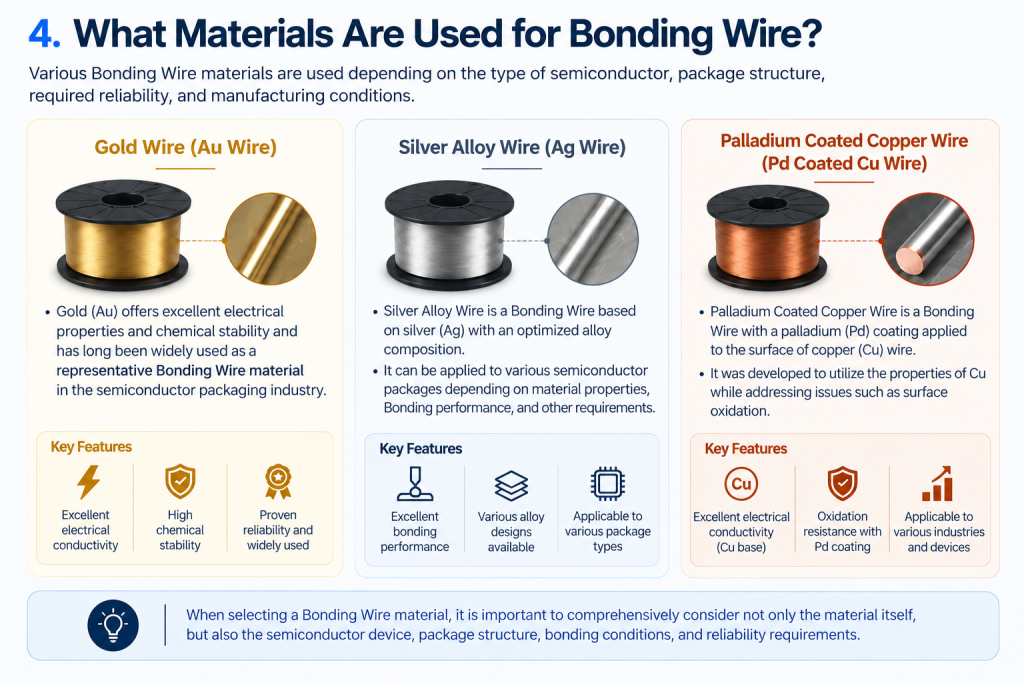
Various Bonding Wire materials are used depending on the type of semiconductor, package structure, required reliability, and manufacturing conditions.
- Gold Wire (Au Wire) : Gold (Au) offers excellent electrical properties and chemical stability and has long been used as a representative Bonding Wire material in the semiconductor packaging industry.
- Silver Alloy Wire (Ag Wire) : Silver Alloy Wire is a Bonding Wire designed with a silver (Ag)-based alloy composition. It can be applied to various semiconductor packages depending on material characteristics, bonding performance, and other requirements.
- Palladium Coated Copper Wire : Palladium Coated Copper Wire is a Bonding Wire with a palladium (Pd) coating applied to the surface of copper (Cu) wire. It was developed to utilize the properties of Cu while addressing issues such as surface oxidation.
5. Where Is Bonding Wire Used?
Wire Bonding is a representative electrical interconnection technology that has long been used in the semiconductor packaging industry.
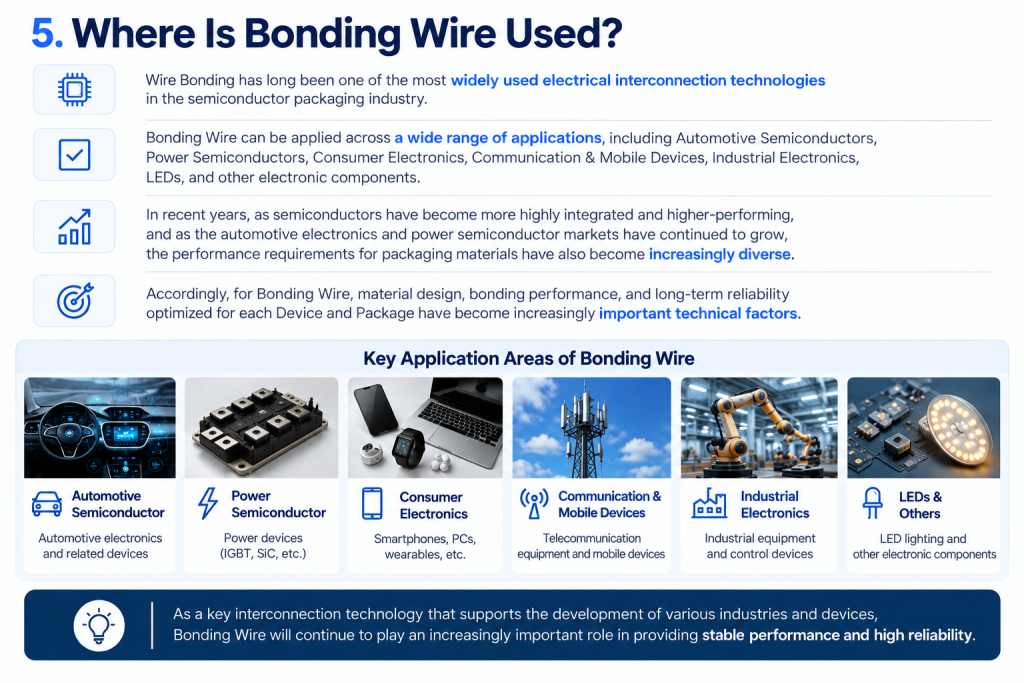
Bonding Wire can be applied across a wide range of applications, including Automotive Semiconductors, Power Semiconductors, Consumer Electronics, Communication & Mobile Devices, Industrial Electronics, LEDs, and other electronic components.
In recent years, with increasing semiconductor integration and performance, as well as the growth of the automotive electronics and power semiconductor markets, the performance requirements for packaging materials have become increasingly diverse.
Accordingly, material design, bonding performance, and long-term reliability tailored to each device and package have become important technical factors for Bonding Wire.
6. LT Metal’s Bonding Wire
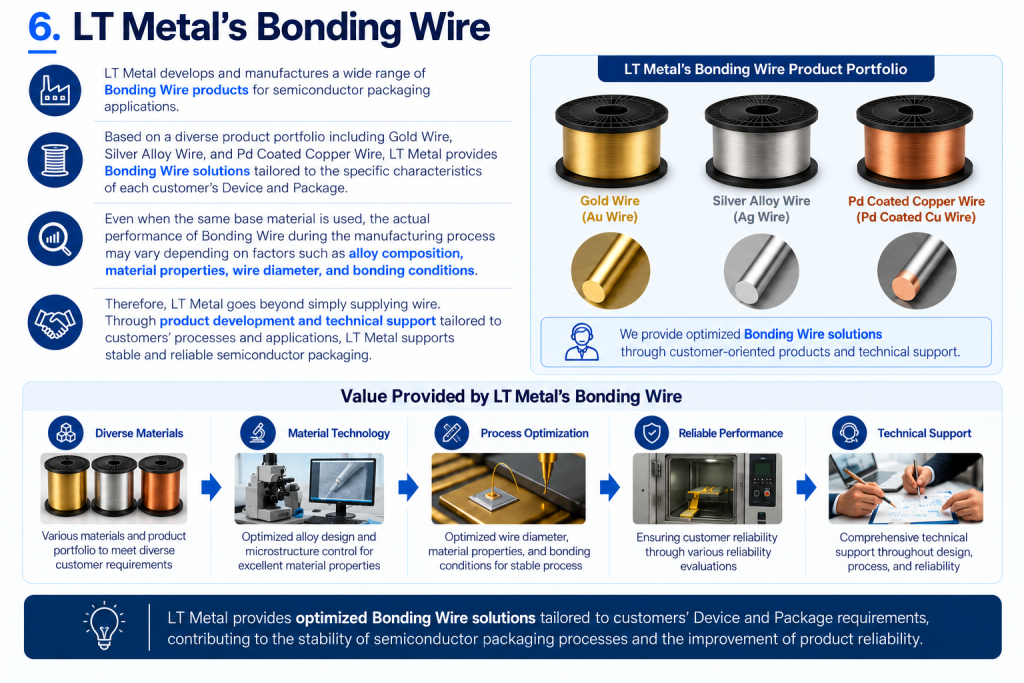
LT Metal develops and manufactures a wide range of Bonding Wire products for semiconductor packaging applications.
Based on a diverse product portfolio including Gold Wire, Silver Alloy Wire, and Pd Coated Copper Wire, LT Metal provides Bonding Wire solutions tailored to the specific characteristics of each customer’s device and package.
Even when the same base material is used, the actual performance of Bonding Wire during the manufacturing process may vary depending on factors such as alloy composition, material properties, wire diameter, and bonding conditions.
Therefore, LT Metal goes beyond simply supplying wire. Through product development and technical support tailored to customers’ processes and applications, LT Metal supports stable semiconductor packaging.
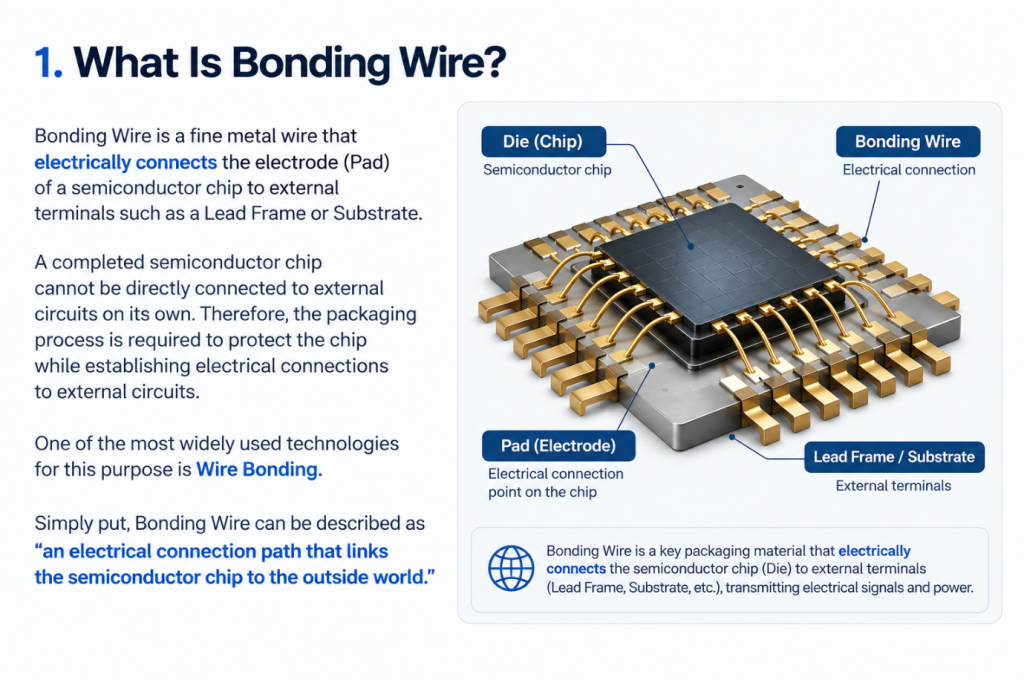
A Small but Essential Connection, Bonding Wire
For countless semiconductors to perform their intended functions, a stable connection between the chip and external circuits is essential.
The fine metal wire responsible for this connection is Bonding Wire.
Although it is extremely thin and barely visible to the naked eye, Bonding Wire is an important material that supports the performance and reliability of semiconductor packages.
In this article, we explored the basic concept and role of Bonding Wire.
Going forward, the LT Metal Packaging Materials Division Blog will introduce our key products, including Gold Wire, Silver Alloy Wire, and Pd Coated Copper Wire, as well as Bonding Wire technologies, technical information related to semiconductor packaging, and various updates from the Packaging Materials Division.